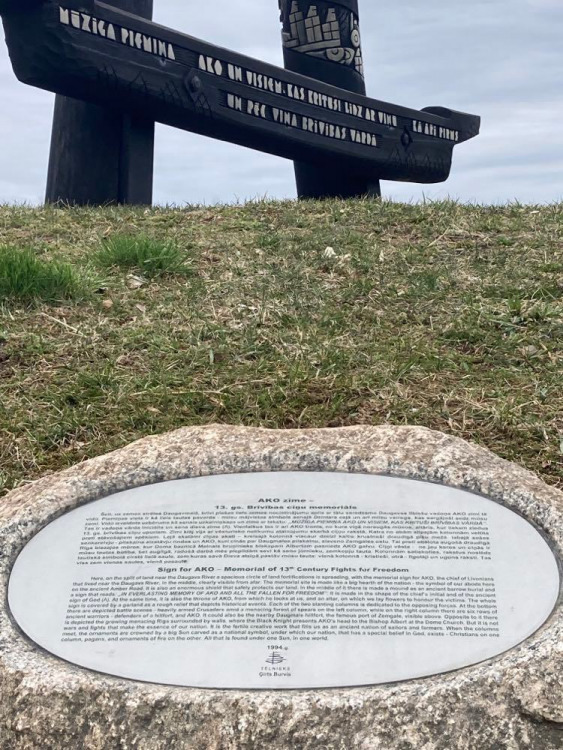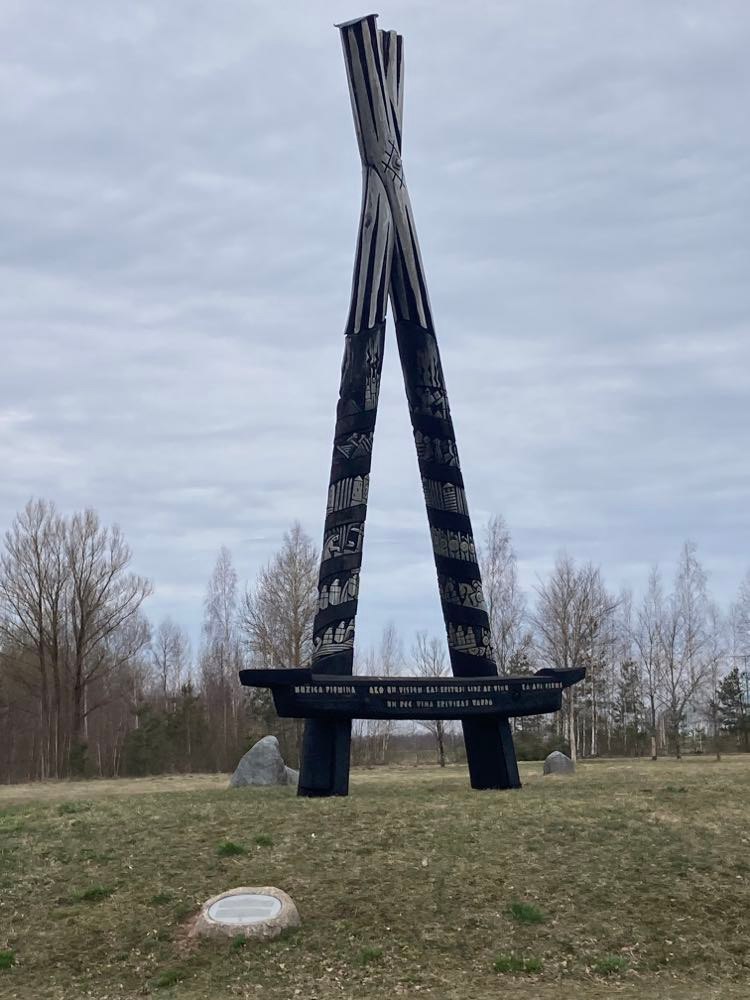
At the beginning of this year, in view of the further development and development of the memorial site for AKO, together with the sculptor Ģirts Burvis, we decided that it would be beneficial to supplement this memorial ensemble with an explanatory sign, which would include an explanation of the author’s concept of the memorial ensemble for AKO and the message of the wooden reliefs of the sigh for AKO at its centre.
It was decided that the object would be a metal plate with text that in turn is embedded in a large boulder near the central wooden mark.
In early April the work was done and implemented, and all interested persons and visitors to the memorial ensemble to AKO can acquaint with the new object on which the following message appears:
Sign for AKO –
Memorial of 13th Century Fights for Freedom
Here, on the split of land near the Daugava River a spacious circle of land fortifications is spreading, with the memorial sign for AKO, the chief of Livonians that lived near the Daugava River, in the middle, clearly visible from afar. The memorial site is made like a big hearth of the nation – the symbol of our abode here on the ancient Amber Road. It is also an enormous shield that safely protects our land. In the middle of it there is made a mound as an ancient barrow burial and a sign that reads: „IN EVERLASTING MEMORY OF AKO AND ALL THE FALLEN FOR FREEDOM’’. It is made in the shape of the chief’s initial and of the ancient sign of God (Λ). At the same time, it is also the throne of AKO, from which he looks at us, and an altar, on which we lay flowers to honour the victims. The whole sign is covered by a garland as a rough relief that depicts historical events. Each of the two slanting columns is dedicated to the opposing forces. At the bottom there are depicted battle scenes – heavily armed Crusaders amid a menacing forest of spears on the left column, while on the right column there are six rows of ancient warriors – defenders of a hillfort, and AKO. It could also be the nearby Daugmale hillfort, the famous port of Zemgale, visible above. Opposite to it there is depicted the growing menacing Riga surrounded by walls, where the Black Knight presents AKO’s head to the Bishop Albert at the Dome Church. But it is not wars and fights that make the essence of our nation. It is the fertile creative work that fills us as an ancient nation of sailors and farmers. When the columns meet, the ornaments are crowned by a big Sun carved as a national symbol, under which our nation, that has a special belief in God, exists – Christians on one column, pagans, and ornaments of fire on the other. All that is found under one Sun, in one world.