
On 11 November 2018, at the Old Cemetery of Salaspils, a memorial stele devoted to the residents of Salaspils – holders of the Order of Lāčplēsis was unveiled. Nine holders of this award are related to Salaspils, and three of them are buried at the Old Cemetery.
Location – Līvzemes iela, Salaspils
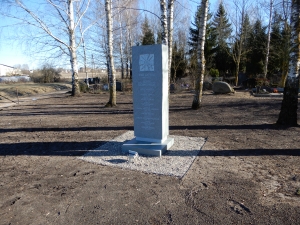
RECIPIENTS OF the Military Order of Lāčplēsis IN SALASPILS MUNICIPALITY
FOR LATVIA IN 1918 – 1920
-
Ervīns Pētersons (1893-1959)
Corporal of the Independent (Student) Company of Latvian Army.
Born on 11 September 1893 at Jaunzemji of Salaspils Municipality.
On 18 December 1918 he voluntarily joined Latvian Army.
The Order was conferred on him for the battle episode at Piņķi Church on 22 May 1919, when Pētersons moved forward with his machine gun to the defence line of Latvian troops, under heavy fire erected the machine gun and fired upon the enemy.
He was wounded, but he did not stop fighting until Latvian company started counter-attack and destroyed the enemy.
Other awards: the Order of the Three Stars, the Order of Viesturs, 4th Class of the Order of the Cross of the Eagle (Estonia), Royal Order of the Sword Knight 1st Class (Sweden), etc.
After World War 2 he lived in Germany.
Died on 22 April 1959 in Geislingen.
-
Herberts Deprejs (1897-1978)
Corporal of the Independent (Student) Company of Latvian Army.
Born on 16 October 1897 at Vedmeri of Salaspils Municipality.
On 1 January 1919 he voluntarily joined Latvian Army in Riga and was enlisted in the Student Company. The Order was conferred on him for the battle episode on 4 May 1919, when Deprejs, who was hiding in an ambush in Kaugurciems vicinity, did not lose his wits during a sudden attack of Bolsheviks. He started to throw hand grenades at the enemy, to make them stop and to warn Latvian forces. He opened fire from his machine gun and stopped the enemy until the reinforcement arrived and countered the attack.
After World War 2 he lived in Australia.
Died on 28 June 1978 in Adelaide.
Buried in Latvian Memorial Park in the Catskills.
-
Hermanis Sproģis (1890-1959)
Private of the Independent (Student) Company.
Born on 11 August 1890 at Panki on Doles sala.
On 9 October 1919 he voluntarily joined Latvian Army.
The Order was conferred on him for the battle episode on 4 November 1919, when during a daring reconnaissance to Lucavsala, Sproģis, together with other soldiers, crossed the Daugava River in the boat and, in a sudden attack forced the enemy out of the island. During this attack, Sproģis acquired a machine gun, which he immediately turned against the Bermontians.
After World War 2 he lived in Germany, afterwards in the USA.
Died on 23 December 1959 in San Francisco, California.
-
Augusts Falkmanis – Folkmanis (1899-1974)
Private First Class of the 1st Liepāja Infantry Regiment of Latvian Army.
Born on 21 May 1899 in Salaspils Municipality.
On 11 July 1919 he voluntarily joined Latvian Army and participated in all battles of the 1st Liepāja Infantry Regiment until the very end of Latvian War of Independence.
The Order was conferred on him for the battle episode on 15 July 1920 at Latgale battlefront near Gasparova Village. Falkmanis used his machine gun to cover the return of Latvian reconnoitrers across the front-line, dispersed the chain of the enemies and facilitated passing 2 cannons and 6 machine guns at the disposal of the Latvian army.
Died on 22 November 1974.
Buried in Baložu Cemetery in Jelgava.
-
Ernests Pravasts-Prāvests (1900-1942)
Corporal of the 8th Daugavpils Infantry Regiment of Latvian Army.
Born on 22 February 1900 in Salaspils Municipality.
Called up for service in Latvian Army on 9 October 1919.
The Order was conferred on him for the battle episode on 25 January 1920 at Latgale battlefront near Sazonova Village. Pravasts was among the first ones who fiercely attacked the said village. As a result of the battle the enemy fled, and they took 9 persons prisoner.
On 14 June 1941 he was deported to Russia and was imprisoned in Usollag Correctional Labour Camp.
Shot on 7 April 1942 in Solikamsk.
-
Mārtiņš Pilvers (1895.-1940.)
Private First Class of Latgale Artillery Regiment of Latvian Army.
Born on 12 September 1895 at Kalna Ķivuti of Doles sala.
Called up for service in Latvian Army in October 1919 in Sigulda.
The Order was conferred on him for the battle episode on 20 November 1919. During an attack to Jelgava, Pilvers together with another telephonist under a heavy fire pulled across the field a communication line between the artillery battery, battle switchboard and the chief of the battle group. This allowed to coordinate activities of the battery and the infantrymen, thus contributing victory in the battle.
Died on 4 December 1940.
Buried in Ķekava Cemetery.
-
Kārlis Grīnvalds (1893-1976)
Private of Kurzeme Artillery Regiment of Latvian Army.
Born on 1 October 1893 in Saikava Municipality.
Called up for service in Latvian Army on 18 July 1919 in Ļaudona.
The Order was conferred on him for the battle episode on 22 November 1919. During an attack to Smārde Tavern, Grīnvalds under an unexpected and fierce fire, brought a cannon to positions and helped to install it. This allowed to silence the machine guns of the enemy and save Latvian forces from imminent danger.
Died on 20 September 1976.
Buried in the Old Cemetery of Salaspils.
-
Alberts Bērziņš (1898-1977)
Private First Class of the 8th Daugavpils Infantry Regiment of Latvian Army.
Born on 21 June 1898 at Sniedzes of Salaspils Municipality.
Called up for service in Latvian Army on 8 October 1919.
The Order was conferred on him for the battle episode on 20 November 1919.
During a reconnaissance in the vicinity of Līvbērze (Liwen Bersen) Manor of Jelgava district Bērziņš encountered a group of enemy’s machine gunners and attacked it. He shot one of the Bermontians and took away an ammunition cart.
Died on 21 April 1977.
Buried in the Old Cemetery of Salaspils.
-
Artūrs Esterliņš (1892-1971)
Sergeant First Class of the 8th Daugavpils Infantry Regiment of Latvian Army.
Born on 4 January 1892 in Salaspils Municipality.
Called up for service in Latvian Army on 11 August 1919 in Riga.
The Order was conferred on him for the battle episode on 11 January 1920. During Latgale battles near Indrica Village Esterlinš as the platoon commander in a rapid attack caused the Bolsheviks to flee, took 12 persons prisoner and rescued the entire company from imminent danger.
Died on 27 May 1971.
Buried in the Old Cemetery of Salaspils.
The Military Order of Lāčplēsis was the first and highest military decoration of the Republic of Latvia. It was given as a mark of honour for military heroism to the soldiers of Latvian Army, former Latvian Riflemen Regiments, as well as foreigners for merit in the struggle for the liberation of Latvia.
The Order had three classes. The Military Order of Lāčplēsis of the Class I (highest class) was given to 11 persons, the Order of Class II – to 61 person, but the Order of Class III – to 2072 persons. The last Order was awarded in 1928. In the former and present-day Salaspils Municipality there were born or buried 9 recipients of the Military Order of Lāčplēsis.
A memorial stele dedicated to the fellow countrymen – recipients of the Military Order of Lāčplēsis at the Old Cemetery of Salaspils was unveiled on 11 November 2018. It was created within the framework of the Latvia’s Centenary project “Remember the Recipients of Lāčplēsis Military Order”, by cooperation of Salaspils Municipality Council and Latvian Cadet Force and Information Centre.