
On 27 September 1605, in the Battle of Salaspils (Kircholm), some resident of Vidzeme (Livland) Heinrih Wrede gave his life to save King Charles IX of Sweden. Around 9000 Swedish soldiers perished in the battle. The memorial stone was set up in 1995.
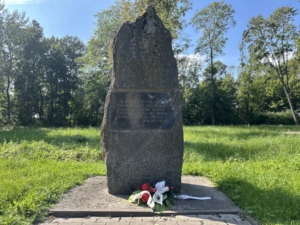
The stone is dedicated to the bright victory of the army of Polish-Lithuanian Commonwealth and the troops of the Duchy of Courland over the Swedish army in the Battle of Salaspils on September 27th, 1605 considered at the time a miracle in military history. Set up in 1996, renewed in 2005.
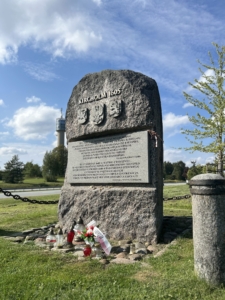
The Battle of Kirchholm
On 27 September 1605 in Kirchholm, in one of the most famous and bloodiest battles of the 17th century in Europe, troops of two superpowers – Polish–Lithuanian Commonwealth (Rzeczpospolita) and Sweden met in the battlefield. This battle was a part of the Polish–Swedish war of1600-1629 on the territory of Latvia, in which the two superpowers fought for domination on the Eastern coast of the Baltic Sea.
This battle is considered to be one of the brightest military victories of the Polish-Lithuanian Commonwealth, when the troops under the command of King Charles IX of Sweden were defeated by the three times smaller troops of Polish–Lithuanian Commonwealth and the Duchy of Courland lead by the hetman Jan Karol Chodkiewicz.
At the initiative of Embassy of Sweden and Latvian Culture Foundation, in 1995 a memorial stone was erected to commemorate the battle.
The memorial stone for the battle was installed in 1996 at the initiative of the Embassy of Poland. In 2005, to commemorate the 400th anniversary of the Battle of Kirchholm, the memorial stone was restored and the coat of arms of Duchy of Courland was added.
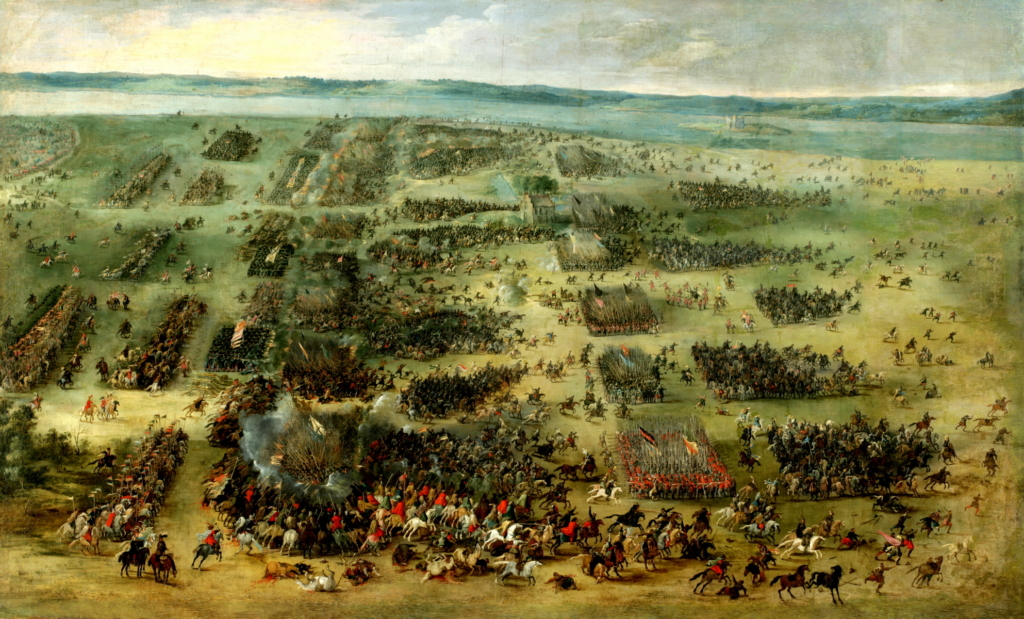
The Battle of Kirchholm. P. Snayers 1619. Photo: A. Lukšenas, La Fondation de France, Sassenage.
St. George’s Church
After the battle part of the fallen soldiers of Swedish army were buried near the church. The church was restored by order of K. Chodkiewicz. Near the church fierce fights took place, during which some parts of the Swedish troops tried to fortify their positions within the walls of the church. In the later years of Swedish rule the church was rebuilt. Both because of Swedish graves and because of rebuilding, St. George’s Church is known as the “Swedish church”. Today there have remained only ruins of the church.
King Charles IX of Sweden (1550-1611)
Duration of reign: 1604-1611. In the battle Charles nearly lost his life. Vidzeme nobleman Heinrich von Wrede rescued the King (at the expense of his own life). Swedish army could be divided in two parts: the main assault force – infantry, armed with muskets and spears, and cavalry, armed with pistols and carbines.
Jan Karol Chodkiewicz (1560- 1621)
The winner of the Battle of Kirchholm, one of the most famous Polish-Lithuanian military commanders.
Friedrich Kettler (1569- 1642)
Duke of Courland and Semigallia. In the Battle of Kirchholm he was the ally of Polish–Lithuanian Commonwealth.